
Types of Pallets Used in International Shipping
Compare the main pallet materials, shipping applications, export requirements, and practical factors that determine the right pallet for your cargo.
Written by Hany Abdelaal
Founder & CEO – Live Freight
Logistics Leader Since 2008
7 min read • Updated July 2026
The Right Pallet Protects More Than Your Cargo
A pallet affects how goods are lifted, stored, loaded, secured, and transported throughout the supply chain.
Choosing the wrong pallet may increase shipment weight, waste container space, create handling problems, or expose the cargo to damage. For international exports, the pallet may also need to meet destination-country packaging and phytosanitary requirements.
The right choice depends on:
Cargo weight and dimensions
Transport mode
Storage conditions
Handling equipment
Destination requirements
Reuse expectations
Total shipment cost
This guide compares the most common pallet types used in international shipping and explains when each option is most suitable.
In This Guide
You’ll learn:
The main pallet types used in freight shipping
The differences between wooden, plastic, metal, paper, and presswood pallets
Which pallets are suitable for export shipments
How pallet material affects weight, durability, hygiene, and cost
When wooden pallets may need to comply with ISPM 15
How transport mode affects pallet selection
Why Pallet Selection Matters
Pallets provide a stable handling base for moving cargo through warehouses, terminals, ports, airports, and distribution centres.
A suitable pallet needs to support the cargo safely, work with the available handling equipment, withstand expected storage conditions, and use transport space efficiently.
For international shipments, there is another consideration: the pallet itself may be subject to destination-country import requirements.
That makes pallet selection part of shipment planning—not simply a packaging decision.
If you are unfamiliar with the wider cargo journey, our International Shipping Process guide explains how shipments move from origin to destination.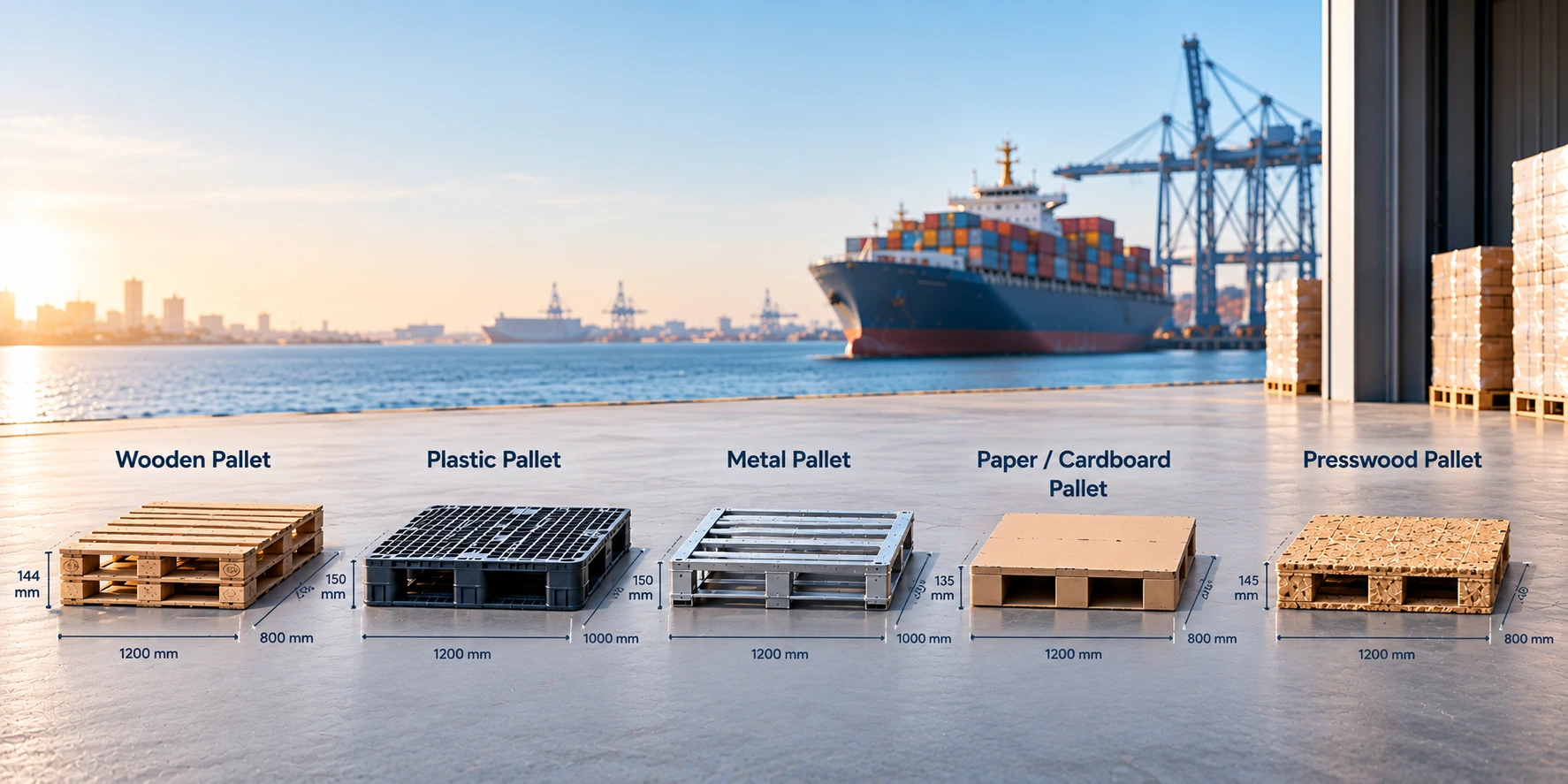
Pallet Types at a Glance
| Pallet Type | Main Advantage | Main Limitation | Typical Use |
|---|---|---|---|
| Wooden | Strong, available, repairable | Export treatment requirements may apply | General cargo and sea freight |
| Plastic | Hygienic and moisture resistant | Higher initial cost | Food, pharma and reusable logistics |
| Metal | High strength and durability | Cost and tare weight | Heavy industrial cargo |
| Paper/Cardboard | Very lightweight | Sensitive to moisture and heavy loads | Lightweight one-way shipments |
| Presswood | Lightweight and practical for export | Load and application limits vary | One-way international shipments |
There is no single material that is best for every shipment. The right choice depends on what the pallet needs to carry and what it will encounter during transportation.
Wooden Pallets
Wooden pallets are widely used for general cargo because they combine strength, availability, repairability, and relatively low cost.
They are suitable for:
General cargo
Heavy cartons
Warehousing
Sea freight
Repeated handling
The main export consideration is the wood itself.
Solid-wood packaging used in international trade may be subject to ISPM 15, depending on the shipment and destination.
Best for: General cargo requiring a strong and economical handling platform.
Before export: Confirm whether the pallet requires approved treatment and compliant marking for the destination.
Plastic Pallets
Plastic pallets are useful where hygiene, moisture resistance, consistent dimensions, or repeated use matters more than the lowest initial purchase cost.
Common applications include:
Food and beverage cargo
Pharmaceutical products
Temperature-controlled supply chains
Clean warehouse environments
Closed-loop distribution
Plastic also avoids the phytosanitary treatment requirements associated with regulated solid-wood packaging.
The trade-off is cost. Plastic pallets generally require a higher upfront investment, which may be difficult to justify for a one-way shipment where the pallet will not return.
Best for: Hygienic, moisture-sensitive, or reusable logistics operations.
Metal Pallets
Metal pallets are designed for applications where conventional pallets cannot provide sufficient strength or durability.
They are commonly considered for:
Heavy machinery
Automotive components
Industrial equipment
High-load applications
Repeated manufacturing movements
Their strength comes with two important trade-offs: cost and weight.
A heavy pallet adds to the shipment's gross weight, so metal should normally be selected because the cargo requires it—not simply because it is more durable.
Best for: Heavy-duty industrial cargo and repeated high-load handling.
Paper and Cardboard Pallets
Paper and cardboard pallets are lightweight options for cargo that does not require the strength or environmental resistance of wood, plastic, or metal.
They may be useful for:
Lightweight cartons
Retail products
One-way shipments
Selected air freight cargo
Their low tare weight can be commercially useful where shipment weight matters.
However, moisture, rough handling, or excessive loads can reduce their performance.
Best for: Lightweight, dry cargo where reducing pallet weight is valuable.
Presswood Pallets
Presswood pallets are manufactured from processed wood material formed under heat and pressure.
They are often used for:
One-way exports
General cargo
Air freight
Operations where low pallet weight matters
Storage environments where nestable pallets are useful
Qualifying processed wood products may fall outside the ISPM 15 treatment requirements that apply to regulated raw wood packaging.
However, exporters should verify the pallet's manufacturing specification and destination requirements rather than assuming that every product described as "presswood" receives the same treatment.
Best for: Selected one-way international shipments where weight and export practicality are important.
What Is ISPM 15?
ISPM 15 is an international phytosanitary standard intended to reduce the movement of pests through wood packaging used in international trade.
It can apply to regulated wood packaging such as:
Pallets
Crates
Dunnage
Packing cases
Other qualifying raw-wood packaging
Where the standard applies, the wood packaging must undergo an approved treatment and carry the required marking.
Some processed wood products manufactured using materials or processes such as heat, pressure, or adhesive may be outside the scope of these treatment requirements.
Before Exporting on Wooden Pallets
Confirm:
Whether the pallet contains regulated raw wood
Whether ISPM 15 applies
Whether the required treatment has been completed
Whether compliant marking is present where required
Whether the destination has additional packaging requirements
Checking this before cargo is palletized and dispatched is considerably easier than resolving a packaging problem at destination.
For shipments moving through Egypt, pallet compliance may form only one part of the import or export process. Learn more about Customs Clearance in Egypt.
Choosing Pallets for Sea Freight
For sea freight, pallet selection should account for strength, moisture exposure, container space, and repeated cargo handling.
Wooden pallets remain common for general containerized cargo, while plastic may be useful where moisture resistance or hygiene is important. Heavy industrial cargo may require stronger specialized platforms.
The critical question is not only whether the pallet can carry the cargo, but whether the complete palletized load uses the container efficiently.
Check:
Pallet footprint
Total palletized height
Gross weight
Load distribution
Stackability
Cargo securing requirements
Larger palletized shipments may be suitable for FCL Shipping, while smaller consignments may move through LCL Shipping, depending on the cargo and route.
Choosing Pallets for Air Freight
Weight and dimensions become particularly important in air freight.
The pallet adds to the shipment's actual weight, while the dimensions of the complete palletized cargo can affect chargeable weight.
This makes lightweight pallet options attractive when they still provide sufficient load strength and handling protection.
If you are calculating an air shipment, our Chargeable Weight Explained guide explains how actual and dimensional weight affect air freight pricing.
Choosing Pallets for Land Freight
For land freight, pallet selection should focus on vehicle compatibility, cargo securing, and loading and unloading conditions.
Consider:
Truck dimensions
Forklift and pallet-jack access
Load distribution
Cargo securing
Cross-border requirements for international road shipments
For international road movements, see Land Freight in Egypt.
For cargo movements between Egyptian ports, warehouses, factories, and delivery points, see Inland Transportation in Egypt.
How Pallet Choice Affects Freight Cost
Pallet cost is only one part of the calculation.
The pallet can also affect:
Shipment weight
Heavier pallets increase gross weight and may influence freight charges.
Space utilization
Poor pallet dimensions can leave unused container or vehicle space.
Stackability
A properly designed palletized load may use available transport capacity more efficiently.
Cargo protection
An unsuitable pallet can create costs through damage, instability, or repacking.
Compliance
Incorrect export packaging can lead to inspections, delays, or corrective handling.
The cheapest pallet is therefore not necessarily the lowest-cost option for the shipment as a whole.
For a broader explanation of freight pricing factors, see Shipping Cost Egypt.
How to Choose the Right Pallet
Before selecting a pallet, answer six questions.
1. What does the cargo weigh?
The pallet must safely support both the total load and its weight distribution.
2. How large is the cargo?
Pallet dimensions should work with the cargo footprint and available transport space.
3. How will the shipment travel?
Sea, air, and land freight create different priorities for weight, space, handling, and environmental exposure.
4. How will the pallet be handled?
Consider forklifts, pallet jacks, warehouse systems, transfers, stacking, loading, and unloading.
5. What does the destination require?
Check applicable packaging and phytosanitary requirements before export.
6. Is the pallet one-way or reusable?
A higher-cost reusable pallet can make sense in a closed-loop logistics system. A one-way export may require a different balance of weight, strength, and cost.
Already Know Your Cargo Details?
If you know the origin, destination, cargo type, weight, and dimensions, you can move from packaging decisions to transport planning.
Explore Available Shipping Routes →
Pallet Selection Checklist
Before your shipment is dispatched, confirm:
Cargo weight and dimensions
Pallet load capacity
Pallet dimensions
Transport mode
Destination country
Export packaging requirements
ISPM 15 applicability where relevant
Handling equipment compatibility
Moisture and storage exposure
Stackability
Cargo securing requirements
One-way or reusable pallet requirement
The right pallet should protect the cargo, work throughout the handling journey, meet applicable destination requirements, and avoid unnecessary weight or wasted transport space.
Planning an International Shipment from Egypt?
If your cargo is already palletized, the information needed for freight planning is straightforward:
Origin
Destination
Cargo type
Number of pallets
Pallet dimensions
Gross weight
Live Freight can use these shipment details to evaluate relevant sea, air, or land freight options.
Start writing here...